
Standing in a showroom trying to decide between awning, casement, sliding and double hung windows is like being asked to pick a favourite tool without knowing what you’re building. Each window type genuinely excels somewhere and genuinely underperforms somewhere else, and most guides only cover one at a time. Here’s the whole decision in one place, room by room.
Awning Windows: Best for Wet or High Areas
One-line verdict: the window that stays open in the rain.
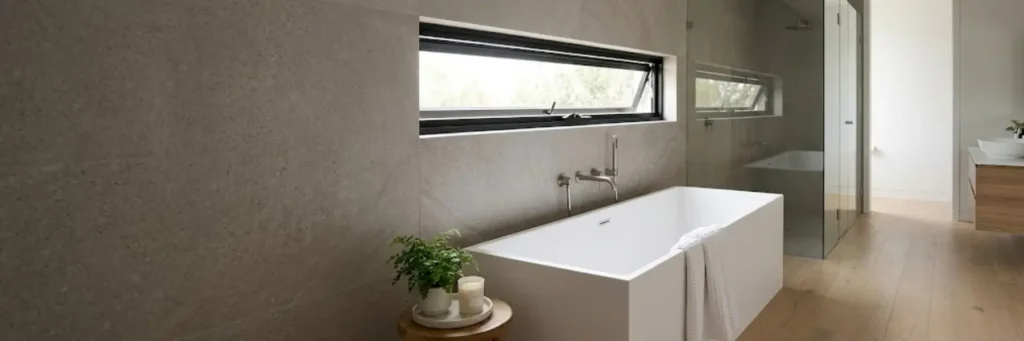
Awning windows are hinged at the top and open outward from the bottom, so the angled sash acts as a small awning over the opening. That’s genuinely useful in Australia, where a sudden downpour shouldn’t mean racing around the house shutting windows.
- Ideal above kitchen sinks, in bathrooms, and in laundries, where you want continuous airflow without worrying about rain.
- Creates a tight compression seal when closed, similar to casement windows.
- Works well positioned high on a wall for privacy plus ventilation.
Casement Windows: Best for Catching a Breeze
One-line verdict: the ventilation champion.
Casement windows are hinged on one side and swing fully outward, clearing the whole frame width. Positioned on the windward side of a room, an open casement can angle to catch a breeze and funnel it inside, rather than just letting air pass by.
- Best suited to living rooms, bedrooms and home offices where maximum airflow and an unobstructed view matter.
- Like awning windows, casements form a compression seal, giving strong airtightness when shut.
- The full swing-out sash means nothing obstructs the glass, so views stay completely clear.
Sliding Windows: Best for Space-Constrained Openings
One-line verdict: the practical, space-saving option.
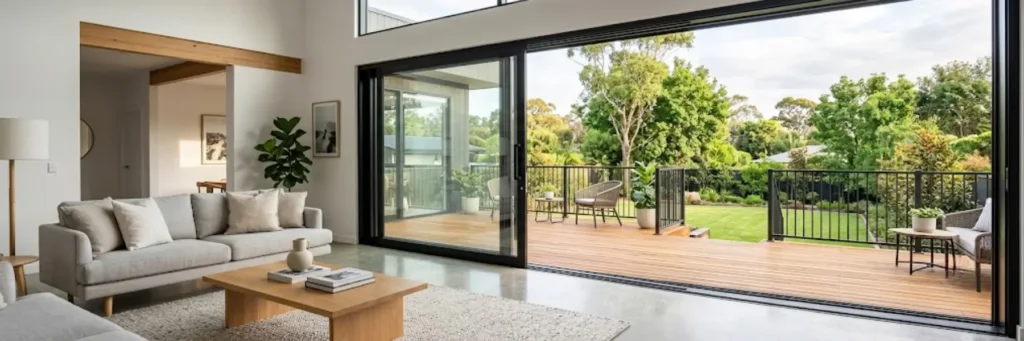
Sliding windows glide sideways within the frame rather than swinging in or out, which makes them the obvious choice anywhere you can’t afford a window that protrudes into a walkway, deck or garden bed.
- Great for larger openings in living areas, since wide glass panels flood a room with light without needing outward clearance.
- Easy for most people to operate one-handed, which matters in busier family spaces.
- The trade-off is sealing: sliders typically use brush seals rather than a compression seal, so they’re generally less airtight than awning or casement windows of the same specification.
Double Hung Windows: Best for Traditional or Heritage Styling
One-line verdict: the classic look with dual-sash airflow.
Double hung windows have two vertically sliding sashes, both of which can move, so you can open the top, the bottom, or both together for a chimney-style airflow that pulls warm air out the top while drawing cooler air in low.
- Suits period homes, heritage streetscapes, and renovations where the traditional look matters as much as function.
- Slightly more hardware-intensive than fixed or sliding windows, which nudges the price up.
- Like sliders, the sash-in-frame design means sealing typically sits behind compression-sealed casement and awning windows.
Ventilation Performance Compared
- Awning: controlled airflow that continues safely through rain, thanks to the angled sash.
- Casement: the widest, most directional airflow of the four, since the entire sash clears the frame.
- Sliding: moderate airflow, limited to whatever portion of the track is open.
- Double hung: airflow from both top and bottom sashes, useful for passive chimney-effect ventilation, though the total opening area is usually smaller than a casement.
Sealing and Energy Efficiency Ranking
From tightest seal to loosest, in typical configurations: casement and awning windows (both compression-sealed) generally lead, followed by double hung, then sliding windows. According to the Australian Government’s YourHome guide to passive design, awning and casement windows, which seal by compression, control air leakage considerably better than sliding windows and doors, whose seals gradually wear from constant friction (source: Australian Government, YourHome, “Glazing”). That doesn’t mean sliders are draughty by default, just that they need good-quality seals and regular maintenance to stay competitive.
Cost Ranking: Cheapest to Dearest
- Sliding windows – generally the most budget-friendly operable option, thanks to simpler hardware.
- Awning windows – slightly more hardware than a slider, but still comparatively affordable.
- Casement windows – similar territory to awning, sometimes marginally higher due to the full-swing hinge mechanism.
- Double hung windows – typically the priciest of the four, owing to the dual-sash counterbalance system.
Choosing awning or casement windows, along with aluminium framing over timber, is one of the more effective ways to manage overall project cost when adding double glazing (source: Canstar, “How much does double-glazing cost?”, March 2025).
Room-by-Room Recommendations
- Bathroom: awning, positioned high for privacy and rain-safe ventilation.
- Above the kitchen sink: awning, since there’s no bench to reach over with a crank handle.
- Bedroom: casement for maximum breeze, or double hung for a heritage-style room.
- Living areas: sliding windows for wide, light-filled openings that don’t intrude on outdoor space.
Double Glazing and Flyscreen Compatibility
All four window types can be specified with double glazing, and doing so is one of the simplest ways to lift a home’s overall energy performance regardless of which style you choose. Flyscreens work a little differently across types: sliding and double hung windows typically use a screen that moves with the sash inside a track, while awning and casement windows, being outward-opening, generally need an externally fitted screen or a retractable internal screen to keep the opening clear.
Tilt and Turn Windows: The European Style Australians Keep Asking About
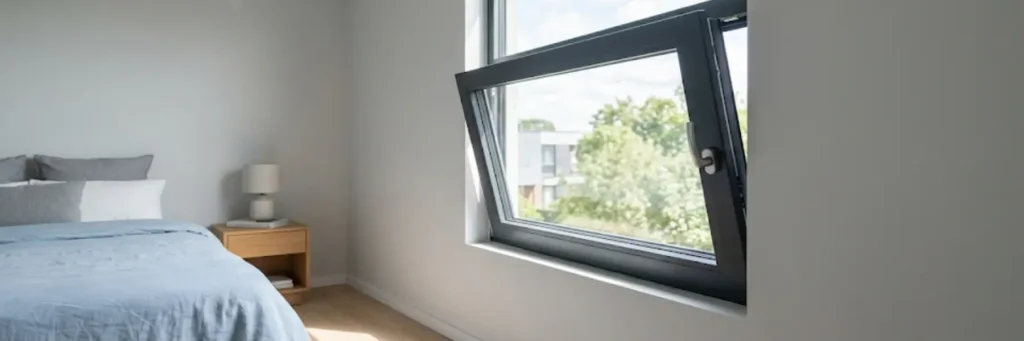
Tilt and turn windows operate two ways from a single handle: tilt inward from the top for secure, controlled ventilation, or swing fully inward like a door for cleaning and full airflow. They’re the default window across much of Europe, which is exactly why they keep coming up in Australian renovation forums. The trade-off is cost, since the multi-point locking hardware is more complex and often imported, typically placing tilt and turn above double hung on the price scale. For homeowners chasing a genuinely European look and top-tier security, they’re worth investigating, though they remain a smaller, more specialised part of the Australian market than awning, casement or sliding windows.
Quick Comparison Table
| Window Type | Ventilation | Sealing | Relative Cost | Best Room |
| Awning | Rain-safe, controlled | Tight (compression) | Low–Mid | Bathroom, kitchen |
| Casement | Widest, breeze-catching | Tight (compression) | Low–Mid | Bedroom, living room |
| Sliding | Moderate | Moderate | Low | Living areas, large openings |
| Double hung | Top and bottom airflow | Moderate | Mid–High | Heritage homes, period rooms |
| Tilt and turn | Excellent, dual-mode | Excellent | Highest | Contemporary renovations |
Not Sure Which Window Type Suits Your Home?
Matching window style to room, orientation and climate is exactly the kind of decision that benefits from a proper conversation rather than a guess. VK Windows & Doors manufactures custom aluminium windows and doors for residential, commercial and architectural projects across Australia.
Explore our aluminium awning windows, aluminium casement windows and aluminium sliding doors, read more about VK, then get in touch for a straightforward, no-obligation quote on your project.
Frequently Asked Question
Which window type is best for ventilation in Australia?
Casement windows generally offer the widest, most directional airflow, while awning windows are the better pick if you need ventilation that continues safely through rain.
Are awning windows cheaper than casement windows?
They’re usually in a similar price bracket, with awning windows sometimes marginally cheaper due to slightly simpler hardware, though size and glazing specification affect this more than the style itself.
Do sliding windows work with double glazing?
Yes, sliding windows are commonly available with double glazing, though their seals are typically less airtight than compression-sealed awning or casement windows of the same specification.