
Nothing spoils a beautiful wall of glass faster than a door that drags. A bifold that rubs, sticks or slowly drifts out of line turns a feature into a frustration, and it’s one of the biggest worries people raise when they’re shopping for bifold doors in Melbourne.
The reassuring part is that a sticking bifold usually isn’t a mystery, and a properly built one shouldn’t develop the problem at all. Here’s what’s really going on, and how to make sure your doors glide for years.
Where the bifold reputation comes from
On renovation forums, the same story comes up again and again. The doors worked beautifully at first. Then, over time, a panel started to catch, the doors needed a firmer push, or the gaps between panels began to look uneven.
The people who build and install bifolds tend to point to the same culprit. In most of these stories, the problem isn’t the panels. It’s the structure the doors sit in.
What actually makes a bifold rub
A bifold is a set of hinged panels that fold and slide along a track. For that to work smoothly, everything has to stay in line: the panels, the hinges, the rollers and the tracks at the top and bottom.
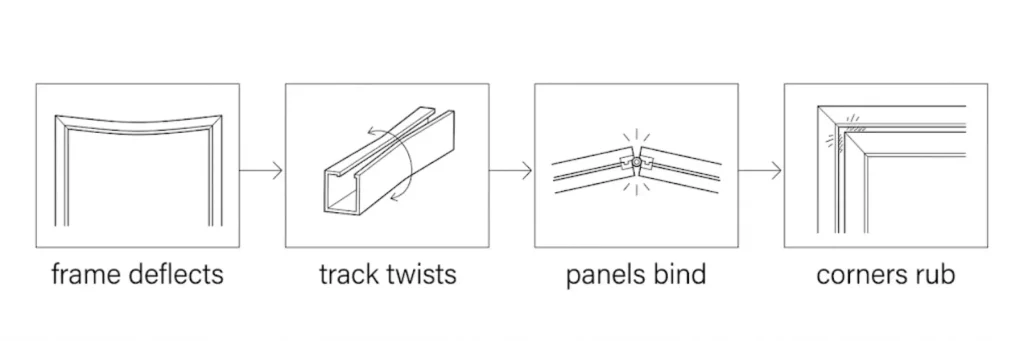
When the frame around the door moves, even slightly, that alignment goes. The panels start to touch where they shouldn’t, and the doors get blamed for a problem that started in the opening. Common causes include:
- Movement in the structure above the opening, so the head of the frame is no longer straight
- A sill or floor that isn’t level, so panels run uphill or downhill
- A frame installed out of square, so the panels never sit quite right
- Debris in the bottom track, which the rollers have to ride over
- Hardware that’s never been adjusted after the building has settled
Most of these have little to do with the glass or the panels. They’re about the opening and the installation.
Top-hung versus bottom-guided, the argument builders and architects keep having
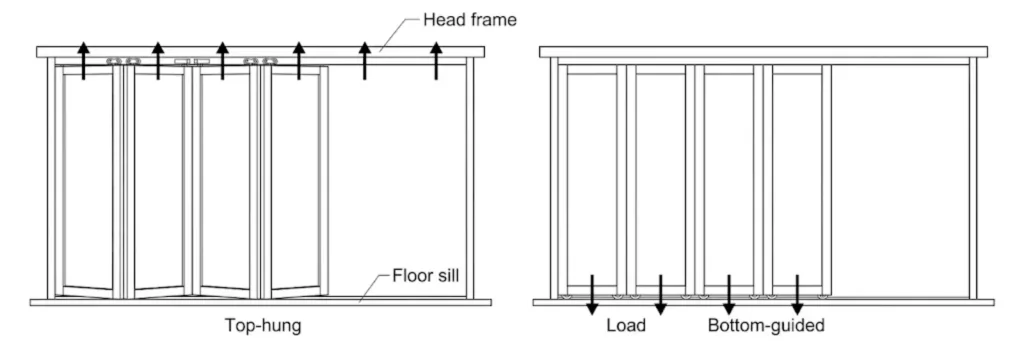
Bifold systems carry their weight in one of two ways, and people in the industry hold strong views on each.
Top-hung: the panels hang from a track in the head of the frame, and the bottom track only guides them.
- The weight is carried by the structure above the door.
- The bottom track carries no weight, which can mean less wear and less trouble from debris at floor level.
- The head of the opening must be strong and straight enough to carry the panels without sagging.
Bottom-guided (bottom-rolling): the panels roll on a track at the sill, and the top track only guides them.
- The weight is carried at floor level, so the structure above has less to carry.
- This can suit renovations, where strengthening the head of an existing opening is harder.
- The bottom track needs to stay clean and level, because the rollers carry the load.
Neither is automatically better. The right choice depends on the opening, the structure above it and the panel sizes. A good supplier will explain which system they’re specifying and why.
The head of the opening is the whole game
Whichever system you choose, the top of the opening matters. With a top-hung system, it carries the full weight of the panels. With a bottom-guided system, it still holds the guide track that keeps the panels upright and in line.
If the beam or lintel above a wide opening moves, the panels can bind. That’s why a wide bifold opening may need additional structural support, such as a steel beam or a suitably sized lintel. Exactly what’s needed depends on the opening and the building, so your builder or engineer should confirm the head is suitable for the doors you’re planning, before the doors are ordered.
This is also where installation earns its keep. VK’s installation and site glazing service covers everything from accurate measuring to final adjustments, so that every component aligns, operates smoothly and performs as designed.
Panel count, leaf weight and why more panels is not always better
More panels can mean a wider opening, but each panel adds something:
- More weight for the track and the structure to carry
- More hinges and joins, each one another point that needs to stay aligned and sealed
- A deeper stack when the doors are folded open
Fewer, larger panels aren’t automatically better either, as each panel then carries more weight on its own. The balance depends on the opening and the system’s limits, so ask your manufacturer what panel sizes and numbers their system allows.
The sealing question, answered honestly
Every bi fold door set has a join between each pair of panels, as well as seals at the top, bottom and sides. More panels means more joins to seal. That doesn’t mean a well-built bifold can’t seal well. It means the quality of the seals and the alignment of the panels matter more.
If sealing is your top priority, it’s worth also looking at French doors where sealing comes first. With only two leaves, they have fewer meeting points.
Six questions that separate a good bifold from a cheap one
Before you commit, ask your supplier:
- What deflection is the head of the opening designed for, and who has checked it?
- Is the track system top-hung or bottom-guided, and why did you choose it for my opening?
- What hardware is used for the rollers and hinges, and how is it adjusted?
- What testing or certification does the system have?
- What are the panel size and weight limits for this system?
- What does the warranty cover, and for how long?
For reference, VK’s aluminium bifold doors are compliant with Australian Standards and independently tested for durability and safety. They carry a warranty of 10 years on non-moving components, 3 years on moving components and 1 year on glass.
Bifold doors in Melbourne: what local conditions add to the spec
Melbourne homes face the same basics as anywhere else: wind, rain and a building that moves a little over time. What that means for your doors depends on your site.
- Wind: the wind rating your doors need depends on your specific site, not just your suburb. Ask your builder or supplier which rating applies to your property.
- Summer heat: aluminium expands and contracts with temperature, so a system with built-in adjustment, and a properly set-up installation, helps keep panels running true through the seasons.
- Weather at the sill: a bottom track is exposed to rain and dirt, so drainage and regular cleaning matter.
- Bushfire areas: VK’s bifold doors are certified to BAL40 with the correct screening solutions, which is relevant in parts of Victoria.
For very wide openings, sliding and stacker doors for wide openings may also be worth considering. If you’re specifying windows too, see how the window formats compare on the same trade-offs, and builders can start from the 7-star spec checklist every door schedule starts from.
Frequently asked questions
Do bifold doors always start sticking over time?
No. Sticking is most often caused by movement in the frame or structure around the door, not by the panels. A properly supported, properly installed set shouldn’t develop the problem.
Top-hung or bottom-rolling bifold doors, which is better?
Neither is automatically better. Top-hung systems need a strong, straight head above the opening. Bottom-rolling systems carry the weight at the sill and need a clean, level track.
Do bifold doors need a steel frame above them?
A wide opening may need additional structural support, such as a steel beam or a suitable lintel. Your builder or engineer should confirm what’s needed for the doors you’re planning.
Are bifold doors harder to seal than French or sliding doors?
Bifolds have a join between every panel, so there are more points to seal. Good seals and accurate alignment matter. French doors have fewer meeting points.
Tips: three questions to bring to your manufacturer
- What deflection is the head designed for, and who has checked it?
- Is the system top-hung or bottom-guided, and why for my opening?
- What are the panel size and weight limits?
Talk to us about bifold doors
As an Australian manufacturer based in Kilmore, we make custom aluminium bifold doors for homes and builders across Melbourne and Victoria. Tell us about your opening, and we’ll help you choose a system that suits it.