
The back of the house is where the big decision happens. Open it right up for summer barbecues, or keep it tidy, sealed and screened against the flies and mozzies that arrive with every warm evening? It’s a question that comes up again and again on Australian renovation forums, and for anyone comparing aluminium French doors in Melbourne with bifolds, it usually boils down to two things: how much you entertain, and how much you hate insects.
Below, we take each deciding factor in turn and say plainly which door comes out ahead, then look at the cases where a sliding or stacker door beats both.
The question every rear renovation ends up asking
When the back of the house opens onto a deck, patio or garden, the choice usually narrows to two styles: external French doors, or bifolds. Both open the living area up to the outdoors. Both suit an aluminium frame. But they behave very differently day to day.
- French doors are a pair of hinged leaves that meet in the middle. VK’s aluminium French doors can open in or out, and come with large opening panels and a multipoint locking system.
- Bifold doors are a run of panels that fold against each other and stack to one side. VK’s bifolds can open fully or partly, running on smooth tracks with robust rollers.
That difference, swinging leaves against a folding stack, drives almost every trade-off below.
How wide the opening is changes the answer
If entertaining is your priority, bifolds usually win. Because the panels fold away and stack, a bifold can open up a much larger part of a wall, creating that seamless flow between inside and out.
French doors still give a generous opening, and with both leaves swung back they make a lovely, open entrance. But the opening is limited to two leaves.
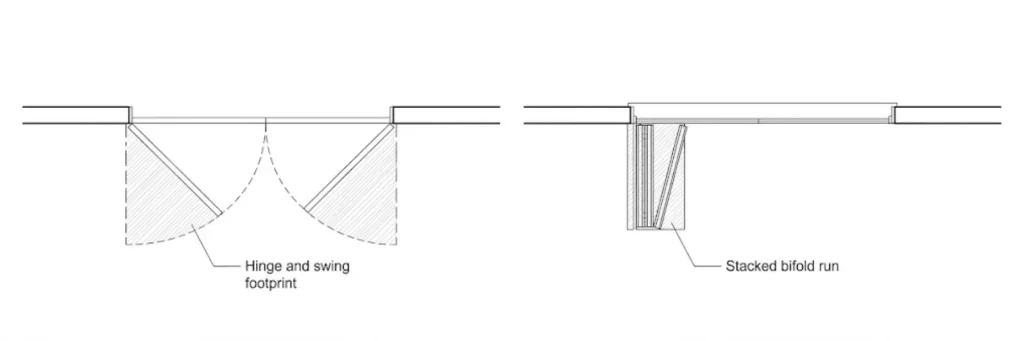
The space around the door matters too:
- French doors need swing room. If they open outward, check the deck or paving. If they open inward, think about furniture.
- Bifolds need stack room. The folded panels sit to one side, so allow space where the stack ends up.
The exact widths, panel counts and clear opening depend on your opening and the system specified. Talk to us about your opening, and we’ll confirm what’s possible.
Flies, mozzies and screens, the genuinely Australian criterion
If flies and mozzies are your main concern, French doors have the edge on screening choice.
- French doors: VK lists them as suitable for insect or security screens.
- Bifolds: VK offers retractable screens, which roll away when you don’t need them.
Both can be screened, so insects aren’t a dealbreaker either way. If you want the option of a security screen across the opening, though, French doors give you more choice. Across VK’s range, flyscreens are available nationwide, with barrier screens available in QLD and NSW.
Whichever you choose, decide on the screen before you finalise the door. It affects how the opening works every day.
Sealing, thermal performance and the double glazing question
Fewer moving panels means fewer places where panels meet. A pair of French doors has one central meeting point, while a multi-panel bifold has a join between every panel. That gives French doors the edge on sealing.
It doesn’t mean bifolds can’t seal well. It means there are more points to consider. Both door types are available with energy-efficient and double glazing options, and both come with an inline reveal as standard for better thermal performance.
If thermal performance matters for your build, compare the WERS ratings for the exact frame and glass configuration you’re considering. You can also read how frame material changes the thermal answer.
Structure and support, what the frame has to carry
Both door types are compatible with all building types, from brickwork to light construction, and both come in standard sizes that suit brick openings without on-site alteration.
The difference is in how they’re carried:
- French doors hang on hinges at the sides of the frame.
- Bifolds run along tracks at the top and bottom of the opening, so the head above a wide bifold needs to stay straight. If it moves or sags, the panels can bind.
A bifold often spans a much wider opening than a French door, and any wide opening needs the right structural support above it. If you’re planning a large bifold, involve your builder early, and ask your manufacturer about the head support the system needs.
What each one does to a budget, honestly, without numbers
We don’t quote prices here, because every job is different. What drives the cost is easier to explain:
- Panel count and size: more panels mean more glass, more frame and more hardware.
- Glazing: double glazing, tinted, obscure and energy-efficient glass each change the cost.
- Hardware: locking systems, tracks and rollers.
- Screens: the type of screen you choose, and whether you need one at all.
Because French doors have fewer panels and less hardware, they’re usually the simpler build of the two. For an accurate comparison, ask us to quote both for the same opening.
When the right answer is actually a sliding or stacker door
Sometimes neither door is right. Sliding and stacker doors may suit you better when:
- you’re short on space: sliding doors don’t swing, so they save space on floors and walls
- you want big views: large glass panels maximise light and the outlook
- you want screens without fuss: sliding doors are screen-ready for insect and security screens
Builders working on energy-efficient homes may find the sliding door spec checklist for a 7-star build useful. Comparing windows too? See how bifold, sliding and stacker windows compare on the same questions.
At a glance
| French doors | Bifold doors | Sliding or stacker | |
| Opening | Generous, two leaves | Widest, panels fold away | Large glass panels |
| Screens | Insect or security screens | Retractable screens | Insect or security screens |
| Sealing | One meeting point | A join between every panel | |
| Structure | Hinged leaves | Tracked stack, needs a straight head | No swing room needed |
| Best for | Classic style, screening, sealing | Entertaining, open walls | Tight spaces, big views |
Frequently asked questions
Are French doors or bifold doors better for entertaining?
Bifolds, in most cases. Their panels fold away to open up more of the wall. French doors still give a generous opening, but only across two leaves.
Can you put a flyscreen on bifold doors?
Yes. VK offers retractable screens for bifolds. If screening is your top priority, French doors or sliding doors, which take insect or security screens, may suit better.
Do French doors or bifolds seal better against weather?
French doors have fewer meeting points between panels, so there are fewer joins to seal. For specific performance, compare the WERS ratings for the exact frame and glass.
Which suits a narrow side or courtyard opening?
It depends on the space around it. French doors need room for the leaves to swing, while bifolds need room for the folded stack. Where neither fits, a sliding door may be the better option.
Tips: three checks before choosing
- Measure the swing zone for French doors, or the stack zone for bifolds.
- Decide on your screen first, as it shapes which door suits.
- Ask your manufacturer about the head support the system needs.
Aluminium French doors in Melbourne, made to your opening
As an Australian manufacturer based in Kilmore, we make custom aluminium French doors and aluminium bifold doors for homes and builders across Melbourne and Victoria. Tell us about your opening, and we’ll help you choose the door that fits the way you live.